
Download
Our Canopy Indirect Calorimetry
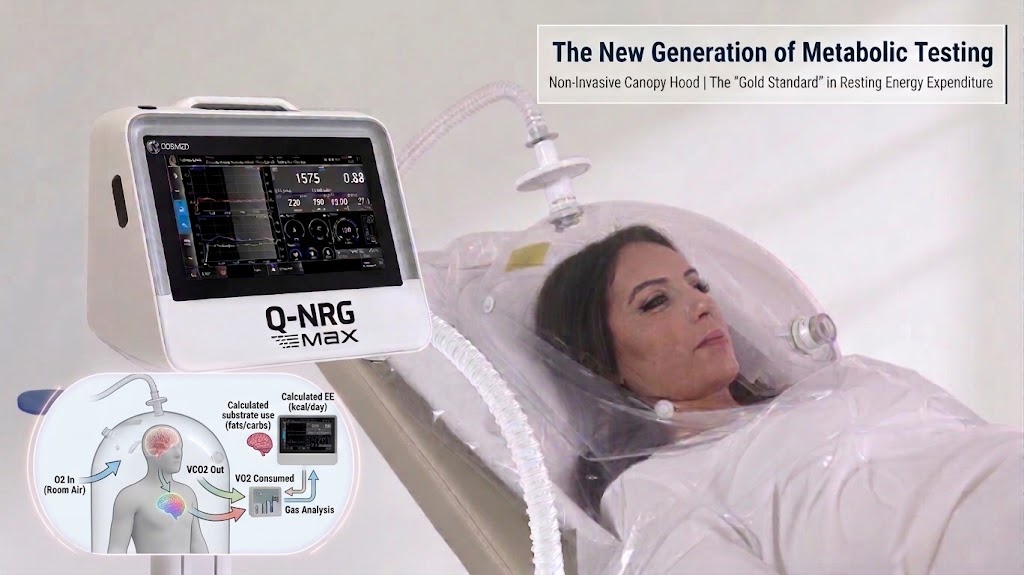
At Body DEXA Fit, we use a COSMED Q-NRG Max with a canopy hood for resting metabolic testing.
The system is designed specifically for metabolic assessment and measures oxygen consumption (VO?) and carbon dioxide production (VCO?). It can also determine substrate utilisation, including the relative contribution of fat and carbohydrate to energy production.
Why use a canopy?
Unlike a mouthpiece and nose clip or a face mask, a ventilated canopy allows you to breathe normally and comfortably while resting.
You will lie comfortably and have time to relax before the measurement begins, allowing your body to settle into a resting state.
A clear canopy is gently positioned over your head and upper body. You simply breathe normally while the system continuously collects and analyses the air around you.
The COSMED system uses a controlled airflow and dilution technique to measure the oxygen you consume and carbon dioxide you produce. These measurements are then used to calculate your resting energy expenditure and other metabolic parameters.
A comfortable way to measure your metabolism
Because you are not required to wear a face mask, mouthpiece or nose clip, the canopy allows you to relax and breathe naturally throughout the assessment.
Research comparing different indirect calorimetry methods has found that ventilated canopy systems can make it easier for participants to achieve a stable measurement during resting metabolic testing.
Importantly, research has also demonstrated that ventilated canopy measurements can provide comparable resting energy expenditure measurements to other established gas-collection methods when appropriate testing protocols are followed.
What does the test measure?
Your metabolic assessment can provide information about:
Why measure your resting metabolism?
Your measured REE can be useful if you are:
- Trying to lose body fat
- Trying to gain or maintain muscle mass
- Planning your calorie intake
- Training for sport or endurance events
- Monitoring changes following a diet or training program
- Interested in understanding your individual metabolism
- Working with a dietitian, nutritionist, exercise physiologist or personal trainer
Stop guessing your calorie requirements
Two people of the same age, sex, height and weight can have different energy requirements.
Your resting energy expenditure is influenced by factors including body composition, fat-free mass, hormones, recent energy intake, physical activity and other physiological factors.
Measuring REE provides an individual data point rather than relying exclusively on a population-based prediction equation.
What happens during the test?
The assessment is simple and non-invasive.
How should I prepare?
For the most reliable resting measurement, your metabolic rate needs to be in a stable resting state.
Please follow these preparation instructions:
- Avoid strenuous exercise for at least 12 hours before testing.
- Do not eat for at least 5 hours before the test.
- Avoid caffeine and other stimulants for at least 5 hours before testing.
- Avoid nicotine for at least 5 hours before testing.
- Avoid alcohol for at least 12 hours before testing.
- Drink only minimal water during the fasting period if required.
- Continue prescribed medications unless your treating clinician has instructed otherwise.
- Arrive rested and allow yourself time to relax before the assessment.
If you are repeating the test, try to perform each assessment under similar conditions and at a similar time of day.
Helpful links
To calculate your ratios of carbohydrate, protein and fat for a given daily Calorie amount, visit free dieting website.
For information on a Guide to Healthy Eating, visit Healthy Active website: